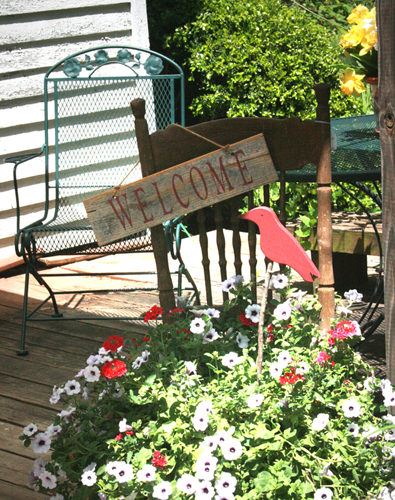
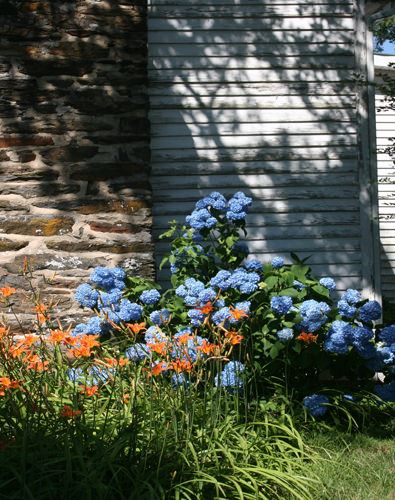
“When the world wearies and society ceases to satisfy, there is always the garden.” Minnie Aumonier “A garden is a friend you can visit any time.” – unknown A pretty garden spot in the front of our retail outlet store.
We are planning an Heirloom Garden on the grounds of Emerson Creek Pottery An Heirloom Garden is designed and planted with plants that would have been grown in a particular time and geographic place. Not to be confused with Heirloom Seeds (open pollinated/non-hybrid), Heirloom Gardens use plants which would have been found used during a given time and place. In the Wade Cabin/Emerson Creek Outlet Store setting, plants will be selected which are traditional for early homesteaders in Virginia, specifically focused on the 1800s – as this era was when the Wade Cabin and surrounding structures were built (lilac, boxwood, forsythia, hydrangea, quince). A working farm illustrating life in the 19th and 20th century can be found about an hour’s drive from Emerson Creek Pottery at the Blue Ridge Institute’s Farm Museum on the campus of Ferrum College: (http://www.blueridgeinstitute.org/). A wonderful Virginia resource for historic plants is the Thomas Jefferson Center for Historic Plants. The link below will take you to the Monticello website.Greetings from the Thomas Jefferson Center for Historic Plants, Thomas Jefferson’s Monticello.
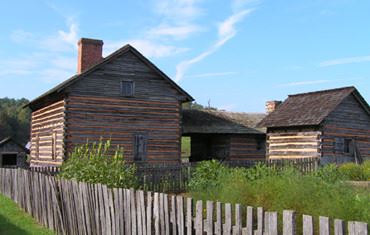
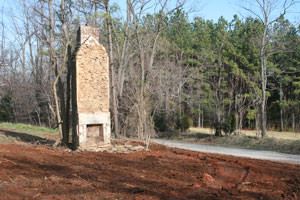
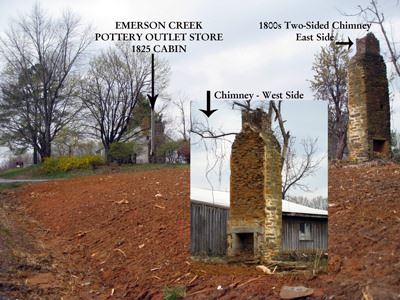
The Wade Cabin, home of Emerson Creek’s Outlet store, was constructed in 1825. A surviving chimney located on adjacent property is carved with “December 24, 1847” along with other carved initials. The initials are carved in a formal script style seen in the early/mid 1800s. This same style of script is carved into stone ledges along the Oregon Trail in western Nebraska and Wyoming. Another chimney recently “uncovered” in spring cleaning at Emerson Creek probably dates to the late 1800s. The structure associated with the chimney was recently torn down because of a severely deteriorated structure. The chimney possesses fireplaces on both the interior and exterior. The structure itself was milled lumber, not logs; we therefore surmise it was built following the 1825 Wade Cabin.